Historical perspectives – A reference to the book “Uganda: The Rise and Fall of Idi Amin” compiled from Drum magazine pages and edited by Adam Seftel. Don't miss the stories of our land, about us, about Uganda - starting Monday, April 13, 2015. Special thanks to my friend P. Mugabi for giving me access to this rich resource.
AdSense
Wednesday, 8 April 2015
Thursday, 2 April 2015
How science can improve interrogation
"Our findings clearly show that interrogation strategies that are based on
building rapport and seek to understand a suspect's motivation to
cooperate are more effective than accusatory practices that look to
raise anxiety levels, fabricate evidence, and minimize a suspect's
perception of their own culpability." More here
Friday, 20 March 2015
Cyclist knocks car, arrested
A man who last Saturday morning was riding
a bicycle along Kampala-Bombo road rammed into a parked commuter taxi, damaging
the vehicle at the back.
The accident occurred near the township of
Wandegeya, a famous place for night life just near Uganda’s oldest and most
popular university, Makerere.
George Opio told of a “darkness during
day” that made him knock and break one of the car’s hind lights.
“I was worn-out after a Friday night
drink. I dashed home early morning only to find myself unable to unlock my door,”
Opio said.
“I recalled I had forgotten my jacket in
the club house and had to ride some five kilometers back. Fortunately I found everything
intact. With that excitement the drink climbed,” he added.
Opio knocked the taxi as he tried to
return home.
The Police were attracted to the scene by
a crowd of boda-boda’s that had
convened a roadside court and was talking more than listening to the parties.
Opio was arrested, taken to a nearby
police station and subjected to an alcohol test with a breathalyzer which
confirmed that he actually had consumed an excessive amount of the substance.
He was released hours later on agreement
that he would contribute UGX 40,000 (USD 14) towards the replacement of the
light.
“That was the day of the Blue Zebra,” the
man said, in reference to Uganda’s commuter taxis most of which are white with
blue stripes.
The water man of India wins 2015 Stockholm Water Prize
These are the leaders we need:
Rajendra Singh of India is named the 2015 Stockholm Water Prize Laureate, for his innovative water restoration efforts, improving water security in rural India, and for showing extraordinary courage and determination in his quest to improve the living conditions for those most in need.
Mr Singh, born 1959, lives and works in the arid Indian state of Rajasthan, where he for several decades dedicated himself to defeating drought and empowering communities. The results of his tireless work are without equal: in close cooperation with local residents, he and his organization have revived several rivers, brought water, and life, back to a thousand villages and given hope to countless people.
On receiving news about the prize, Mr Singh said “this is very encouraging, energizing and inspiring news. Through the Indian wisdom of rainwater harvesting, we have made helpless, abandoned, destitute and impoverished villages prosperous and healthy again. More of the story here at www.siwi.org
Thursday, 19 March 2015
3-year old boy asks to change school because he hates books
John Chris, 3, is a famous boy in
his zone in Gayaza, Wakiso district. He has so many friends, young and old,
including market vendors. When he was about one and a half years, he adopted a habit
of collecting “taxes” from roadside stalls in the neighbourhood.
The confidence with which he
would demand “taxes” made very popular.
“Njagalayo akokulya (I want
something to eat),” he would tell the sellers, not giving up until he had got
what he wanted. Even the days he would be unbothered about them, the sellers
would beckon him to pick his “taxes.” He dropped this habit by himself when he
was close to two and a half years.
On February 2, 2015, John Chris
woke up very early in the morning, excited that he was starting school,
finally. He had on several occasions jumped in the back sit as his father drove
his two elder sisters to school and felt that he too belonged there.
Clad in a white shirt, grey
short, white socks and black shoes, John Chris smiled for the camera before holding
hands with his father to walk to school.
Everywhere he passed he was
cheered on by women and children, the people he had always interacted with in
the days of staying home, eating and playing.
“Am I going to school to play
football and sing?” He asked his father as they neared the school gate.
So many kids were crying,
understandably missing their homes and parents. John Chris, who likes to refer
to himself as a “big man,” promised his father he would not cry.
But soon after clearing with the
administration, his father handed him over to his teacher to be. When she led
him in the opposite direction, John Chris looked back at his father and threw
tantrums. He probably had sensed life would never be the same again.
The following day he refused to
go to school. He told a friend in the neighbourhood that he had finished school.
His father did not bother him knowing that it was just the beginning. But even
the day after John Chris did not want to return to school.
He became the wailing man on the
road every morning for over two weeks. It didn’t matter whether he was at the
back of his grandmother or in his father’s car. He just kept crying on his way
to school. He finally got used and the crying stopped.
But on March 8, 2015, just one
month and a few days into school, John Chris shocked his father with a new proposal.
“Papa I want to change school. I
am tired of this one,” he told his father who had just returned from their little
farm in the countryside where he had been for most of the weekend.
“Why do you want to change school?”
Asked the father.
“I don’t want this school of
books,” the boy said.
“Which school do you want,” asked
the father.
“I want a school with things to
play with,” John Chris replied.
![]() |
|
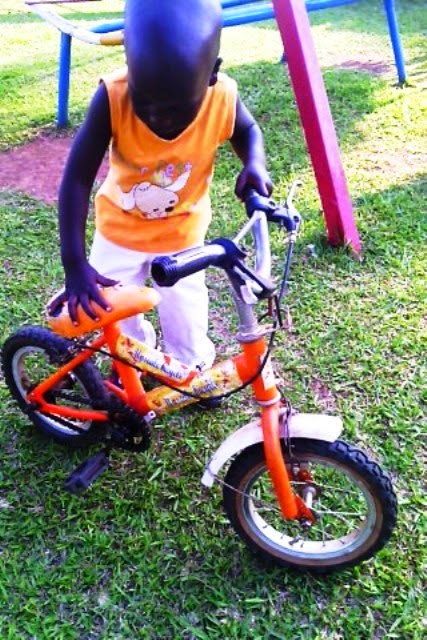
John Chris tries several things with his bicycle seven
months before starting school
|
His kindergarten, or nursery school, has some things for kids to play with, including swings, but the boy’s problem is books. He must be bored with fidgeting to scribble letters in a book and shouting “ABCD...”
There is a big problem in our kindergarten
education. Oxford learners’ dictionaries define a kindergarten as a school or class to prepare children aged five for school.
And our Wikipedia calls it a preschool
educational approach traditionally based around playing, singing,
practical activities such as drawing, and social interaction as part of the
transition from home
to school.
Although a kindergarten child
should be typically five or six years, in Uganda we take there our children
even before they are three. There are several reasons for that including tight
work schedules for parents and lack of appropriate and affordable helpers to
keep our children at home.
At that age, children should have
more physical things to play with, to work with. Instead, our kindergartens force
the little children to cram the typical rhetoric of our formal primary education.
They are not given a proper opportunity to think for themselves, and act. This method
of pushing knowledge into heads continues through primary, secondary and even
university education. The more the teachers push, the more knowledge
evaporates. In the end, we get graduates of nothing but years, unable to create
anything.
![]() |
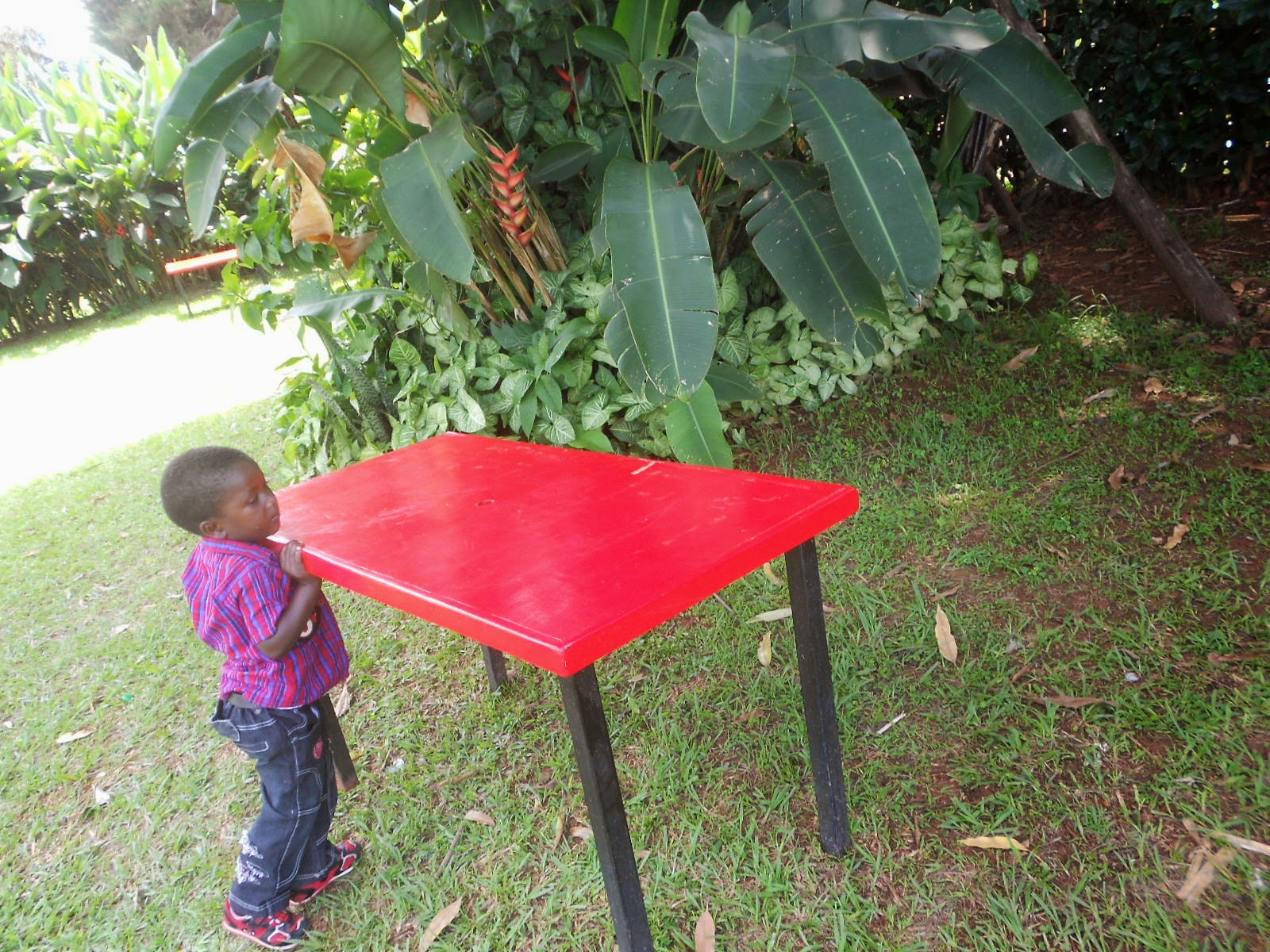
| Kids always want to be doing something but we sometimes beat them out of it - we are wrong on many occasions |
We need an alternative system of
education – one which will, from day one, keep our children engaged in doing or
producing something. If John Chris was provided with some semblance of bricks,
sticks and iron sheets, and challenged to build a house, I believe he would find
school more interesting. What do you think of our kindergarten, primary,
secondary and university education?
Thursday, 5 March 2015
Uganda’s problem in a nutshell: “Chronic political instability and erratic economic management since self-rule”
![]() |
| Coffee, one of Uganda's major forex earners. |
This statement is from Wikipedia:
Endowed with significant
natural resources, including ample fertile land, regular rainfall, and mineral
deposits, it is thought that Uganda could feed all of Africa if it were
commercially farmed. The economy of Uganda has great potential, and it appeared poised for
rapid economic growth and development.
Chronic political instability and erratic economic
management since self-rule has produced a record of persistent economic decline
that has left Uganda among the world's poorest and least-developed countries.
Oh my Uganda!
Tuesday, 27 January 2015
Making Movies – Journalist William Odinga on filming with farmers from Same, Tanzania
![]() |
| Farmer Rizaeli Samueli (sweeping), James Mbiri (with camera) and I. Photo by Liz Agiro |
Dawn has broken and from the compound of my hotel, Nzoroko, I see sunrays pierce though the mountains, forcing the dark morning mist to fade away rapidly. Read more here
![]() |
| COMPETITION: Who has got the toughest look? L-R: Liz Agiro, Bakari, Dosteus Lopa, William Odinga. Photo by James Mbiri |
Thursday, 8 January 2015
A desperate struggle to manage floods
In May last year, floods displaced and killed several people in
Bundibugyo, Kasese and Ntoroko districts. But there is a bigger story
unfolding before our eyes. Read story here
Subscribe to:
Posts (Atom)


